CONTACT US
|
Wechat
WeChat:+8605925523433Wechat QR code,Contact us
WeChat:+8605925523433Wechat QR code,Contact us


Russia is generally a coffee-consuming and processing market rather than a commercial coffee-growing origin. “Russian coffee” commonly refers to coffee sold for the Russian market, operated by a Russian brand, or roasted and packed locally.
Product pages should identify the bean-growing origin, roasting location, and packaging location separately.
For roasters developing drip bags, machine stability depends on more than coffee and bag dimensions. In a dry production environment, coffee fines and plastic packaging film may exhibit static-related behavior, including particle adhesion, film attraction, or unstable tracking.
Guidance from the US Occupational Safety and Health Administration notes that dry powders can accumulate static charge through friction during transfer or mixing and recommends appropriate grounding, bonding, and dust-control precautions.
This is not Russian regulation and does not replace a professional factory risk assessment. It does illustrate that dust and static should not be treated only as cosmetic packaging concerns.
Static behavior is not determined by relative humidity alone. Material properties, grounding, friction, dust levels, equipment condition, and plant layout can also contribute.
Possible observations on a drip coffee line include:
Fines adhering to the filter.
Coffee entering the ultrasonic joining area.
Outer films clinging together.
Unstable film tracking.
Light film waste adhering to equipment.
Changes in coding or registration position.
Dust becoming airborne again during cleaning.
Record the time, environmental condition, material lot, and operating speed before selecting corrective action.
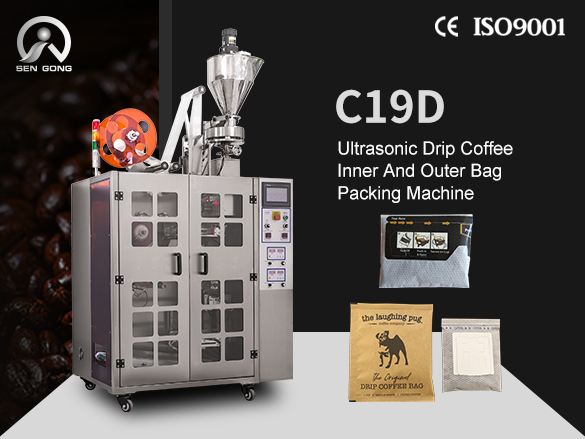
Depending on the model and configuration, an inner and outer bag machine may integrate coffee dosing, filter formation, ultrasonic joining, hanging-support handling, individual outer wrapping, and coding.
Changes in bulk density, particle distribution, and flow can alter the delivered weight. Fines adhering inside the hopper or filling path may also affect consistency.
High-frequency mechanical vibration joins compatible filter material. It creates the filter seam but does not automatically remove coffee from the joining area.
The process is not entirely free of localized heat, and not every filter paper or nonwoven material is compatible.
Supports should remain consistently positioned and unfold easily. Static attraction affecting light materials may require investigation using the actual filter structure.
Film is transported, registered, cut, and heat-sealed around the inner filter. Static, web tension, and roll alignment can influence tracking and finished appearance.
Film-position variation may also shift the printed date. Acceptance should inspect coding, registration, and cutting together.
Ultrasonic joining requires suitable contact between filter surfaces. Grounds in the sealing area may interrupt the seam, reduce local strength, or create an irregular appearance.
Possible causes include:
Excessive fines.
Misaligned filling outlet.
Excessive product volume.
Particle rebound during filling.
Air movement near the machine.
Static attraction on the filter.
Insufficient cleaning during continuous operation.
Higher ultrasonic power alone may not resolve contamination. Grind, filling, material compatibility, static, and cleaning should be assessed together.
Film sticking or particle adhesion does not always prove a static problem. Incorrect tension, contamination, roll installation, and material-lot variation may create similar symptoms.
A structured investigation can:
Record temperature and relative humidity.
Record coffee and material lots.
Inspect grounding and bonding.
Clean film guides and sealing areas.
Confirm roll direction and tension.
Observe behavior at a controlled lower speed.
Compare with an approved material lot.
Document results before and after control measures.
Any grounding, electrical, dust-extraction, or static-control modification should be designed by qualified professionals and comply with applicable local requirements.
Film misalignment may shift artwork, change bag length, place seals over text, or move the tear point.
Increasing tension may change the symptom temporarily but could introduce stretching, wrinkles, or seal movement.
Inspect:
Centering of the film roll.
Alignment of unwind and guiding components.
Flatness of the roll edge.
Clarity of registration marks.
Sensor position and sensitivity.
Stability of tension control.
Film-to-film adhesion.
Synchronization of pulling and sealing.
When the issue occurs only with one film lot, investigate the material before declaring a machine failure.
Specific controls depend on the risk assessment, machine design, and applicable regulations. They may involve grounding, bonding, environmental control, suitable dust extraction, or appropriately selected static-control devices.
Consider:
Suitability for a food-production area.
Whether the control disperses dust.
Effects on coffee and filters.
Cleaning and maintenance.
Suitability for the classified operating area.
Operator training.
Inspection and maintenance records.
Ordinary compressed air should not be used casually to disperse accumulated coffee dust. The plant should establish cleaning methods based on risk assessment and machine instructions.
As the machine accelerates, the frequency of coffee movement, film transport, and material friction changes. A successful slow trial does not prove stability at the planned speed.
At each speed stage, check:
Net weight.
Dust distribution.
Grounds in inner seams.
Support position.
Film tracking.
Print registration.
Outer-seal integrity.
Dust accumulation after continuous running.
The final speed should reflect finished-pack yield, cleaning needs, and safe operation—not a brief maximum-speed result.
Coffee, filters, or film moved from a cold storage area into a warmer production room may undergo physical changes. Under some conditions, condensation may become a concern.
The plant should follow supplier instructions and internal procedures for storage and conditioning before opening materials.
Check:
Whether the film is dry.
Whether the coffee package remained sealed.
Whether the filter absorbed moisture or deformed.
Whether the material condition is suitable for processing.
Whether trial tracking and seals are normal.
Do not apply a universal conditioning time. Material structure, temperature difference, and supplier guidance should determine the procedure.
Russian-market packs may require Russian-language product information, brewing instructions, date coding, and machine-readable codes.
Qualified professionals should confirm applicable labeling requirements. The machine project should provide suitable artwork and coding areas.
Trial film should be checked for:
Accurate Russian text.
Readability at the final size.
Coding clear of important text.
Cutting clear of instructions.
Reliable registration detection.
Scannable barcodes or QR codes.
Correct front-and-back orientation.
Accurate translation can still become a defective package if the machine cuts through the text.
Xiamen Sengong Packing Equipment Co., Ltd supplies drip coffee, tea bag, and other beverage packaging equipment. Buyers can also review related products through the company’s VIPacker website.
The C19H Ultrasonic Drip Coffee Inner and Outer Bag Packing Machine is one model available for further evaluation.
Suitability should be tested with the actual coffee, filter, and printed outer film. Speed, dimensions, coding, and optional functions should be documented in the agreed technical specification.
Provide:
Actual roasted and ground coffee.
Particle and fines information.
Target dose.
Inner and outer packaging materials.
Russian artwork samples.
Expected room-temperature and humidity ranges.
Planned production speed.
Existing dust and static controls.
Coding, easy-tear, or nitrogen requirements.
Cleaning and product-change frequency.
When machine performance differs between dates, environmental records help identify the cause.
An acceptance report can include:
Trial date and time.
Temperature and relative humidity.
Coffee and material lots.
Operating speed.
Continuous-run quantity.
Net-weight sampling.
Inner-seal contamination and integrity.
Film tracking and outer-seal results.
Dust observations before and after cleaning.
Finished-product brewing results.
These records provide a reference for seasonal and production-area changes.
Reliable Russian-market drip coffee packaging depends on more than the equipment model. Coffee fines, filters, outer film, environmental conditions, and speed influence dosing, sealing, and tracking together.
An ultrasonic drip coffee bag packing machine can integrate filling, inner-filter joining, and individual outer wrapping. Environmental records, professionally designed static controls, dust management, and trials with real materials help maintain stable operation.
A mature line should work in controlled conditions and provide enough data to explain changes when conditions vary.
It more commonly refers to coffee sold for the Russian market, operated by a Russian brand, or processed locally. The actual growing origin should be stated separately.
No. Static behavior also depends on materials, friction, grounding, and equipment condition. On-site evidence is required.
Not necessarily. Fines, filling position, filter capacity, material compatibility, and static attraction should be checked first.
Follow the material supplier’s instructions and the plant procedure. Confirm that the film is dry, stable, and free from condensation before production.
Counseling Hotline
+8613779964655
E-Mail:sales@quickerpack.com
Mobile:+8613779964655
TEL:+8613779964655
Addess:228, Tianfeng Road, North Industrial Zone, Jimei District, Xiamen, Fujian, China.
CopyRight 2004-2026 Xiamen Sengong Packing Equipment Co.,Ltd All Rights Reserved XML MAP