CONTACT US
|
Wechat
WeChat:+8605925523433Wechat QR code,Contact us
WeChat:+8605925523433Wechat QR code,Contact us

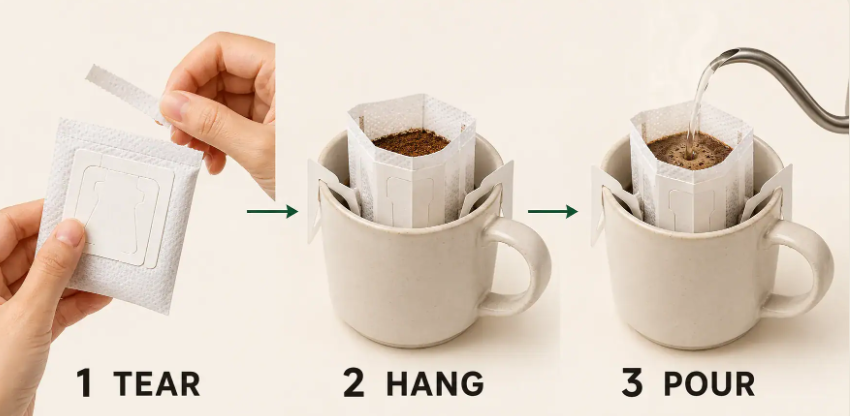
Germany is not a coffee-growing country, but it has a mature market for coffee roasting, retail and home consumption. For brands serving the German market, consumers often value both coffee flavor and practical details: clear product information, reliable preparation and dependable packaging. Drip coffee bags can bring these needs together in a standardized single-serve format.
A drip coffee bag, also called a hanging-ear coffee bag, contains a measured portion of ground coffee inside a filter bag. Consumers attach the supports to the rim of a cup and add hot water to prepare filtered coffee. The format does not require a coffee machine, making it suitable for offices, homes, hotels, travel, e-commerce sampling and corporate gifts.
A strong drip coffee bag should not depend only on origin claims. Each pack should deliver a brewing result that is as consistent as possible. For Germany ground coffee, this requires a stable relationship among roast profile, coffee grind, coffee dose, filter bag and outer packaging.
Brands can create different product lines:
Everyday balanced coffee: Medium-roast blends with smooth, nutty, caramel or cocoa-like notes;
Dark-roast coffee: Products for consumers who prefer bold flavor, with coffee grind adjusted for filter extraction;
Single-origin coffee: Products that communicate origin, process method, roast date and flavor notes;
No-equipment office coffee: Convenient products with simple brewing instructions for meeting rooms and shared workspaces;
Gift and tasting sets: Mixed roast or origin selections for comparison and discovery.
The extraction process of a drip coffee bag differs from espresso and French press preparation. Coffee ground too finely may slow water flow, clog the filter or increase bitterness. Coffee ground too coarsely may produce under-extraction and a weak cup.
The final ground coffee should be tested with the actual filter bag. Brands should set the grind range based on coffee dose, target cup volume, pouring method and water flow. During development, record:
Coffee weight per bag;
Grind particle range;
Recommended water temperature and total water volume;
Staged pouring method;
Target brewing time;
Sensory evaluation results.
These data help create repeatable production standards and accurate consumer instructions.
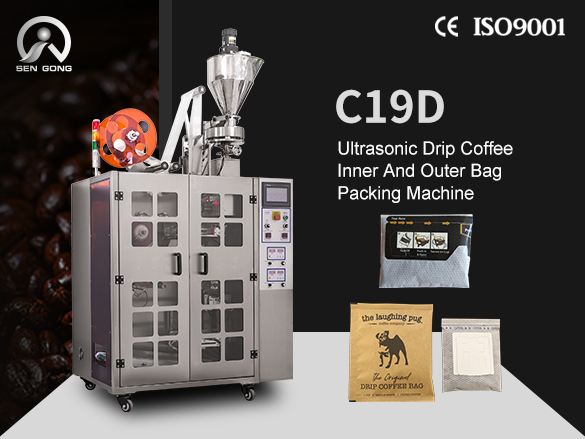
Depending on configuration, a drip coffee bag packaging machine can integrate automatic coffee dosing, filter-bag forming, hanging-ear attachment, individual outer-envelope packing and optional nitrogen flushing. For Germany ground coffee products, the focus should be on control, stability and validation.
Accurate dosing
Coffee density varies with roast degree, particle size and static charge. Real-product trials are needed to verify consistent fill weights.
Reliable filter bags and hanging ears
Filter bags should balance water flow and strength; hanging ears must remain stable on the cup during brewing.
High-barrier outer-envelope protection
Ground coffee is sensitive to oxygen, moisture, light and odor transfer. Individual high-barrier envelopes help protect quality through storage and transport.
Optional nitrogen flushing
Projects with longer logistics cycles or higher freshness requirements may evaluate nitrogen flushing. Final shelf life should be based on product, packaging and storage tests.
Batch traceability and information management
Outer envelopes and cartons can include batch codes, dates, roast information and traceability identifiers to support retail and supply-chain management.
When consumers open a drip coffee bag, they need simple and accurate guidance. The outer envelope can use illustrations to show how to attach the bag, recommended water volume, pouring steps and brewing time. It can also present roast level, flavor notes, origin information and net content.
For Germany and other export markets, labels should be reviewed against destination-market requirements for language, date marking, origin claims, recycling information and other compliance details. Accurate, clear and easy-to-understand information strengthens brand credibility.
Before equipment selection or mass production, use the final coffee, filter bag and outer packaging film in real trials. Verify:
Is net coffee weight consistent?
Are filter bags properly formed and hanging ears secure?
Are outer-envelope seals neat and reliable?
Does transport simulation reveal powder leakage, bag damage or deformation?
Are water flow, aroma and cup flavor consistent when brewed as instructed?
Testing both machine stability and consumer brewing experience helps make a drip coffee bag more suitable for long-term retail and repeat purchases.
Xiamen Sengong Packing Equipment Co.,Ltd provides packaging equipment solutions for drip coffee bags and single-serve ground coffee products. Brands can select suitable configurations based on coffee grind, per-pack dose, output targets, filter-bag specifications, outer-envelope formats and freshness requirements.
Learn more:
Drip coffee bag development for Germany ground coffee should aim to make every cup more predictable. With a compatible grind profile, stable dosing and filter-bag forming, high-barrier outer envelopes and clear brewing guidance, brands can turn ground coffee into a high-quality single-serve product for modern retail, office and travel occasions.
Counseling Hotline
+8613779964655
E-Mail:sales@quickerpack.com
Mobile:+8613779964655
TEL:+8613779964655
Addess:228, Tianfeng Road, North Industrial Zone, Jimei District, Xiamen, Fujian, China.
CopyRight 2004-2026 Xiamen Sengong Packing Equipment Co.,Ltd All Rights Reserved XML MAP