CONTACT US
|
Wechat
WeChat:+8605925523433Wechat QR code,Contact us
WeChat:+8605925523433Wechat QR code,Contact us

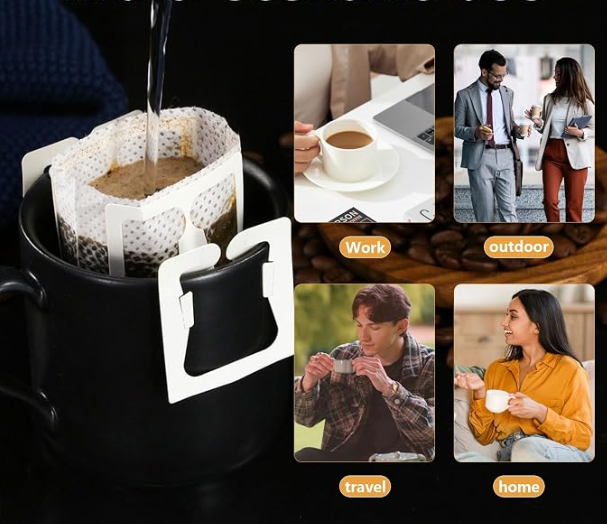
Saudi Arabian coffee is more than a beverage. It carries cultural meaning related to hospitality, sharing, and daily social occasions. Traditional Saudi coffee, often called Gahwa, is commonly based on lightly roasted coffee and may include cardamom or other spices. It is typically served in small cups when welcoming guests.
At the same time, the modern Saudi market offers opportunities for specialty coffee, pour-over coffee, single-origin products, and portable coffee formats. For roasters, coffee brands, and hospitality suppliers, drip coffee bags can connect cultural flavor inspiration with modern convenience.
A drip coffee bag holds a measured coffee portion inside a filter with fold-out supports and protects it in an individual outer pouch. The consumer places the filter over a cup and adds hot water to brew coffee.
Traditional Gahwa does not use the same brewing approach as a hanging-ear drip bag. It may use a relatively fine grind and spices, prepared through boiling or steeping, while a drip bag requires water to flow consistently through the coffee and filter material.
For this reason, a traditional Saudi coffee recipe should not be assumed to work directly in a drip bag. If powder is too fine, or spice-particle size and ratio are unsuitable, the result may include slow water flow, filter blockage, uneven extraction, or an unbalanced cup.
Two product routes can be considered for Saudi-style drip coffee:
A modern specialty route using Arabica coffee formulated for filter brewing, with a focus on origin, roast, and flavor;
A culture-inspired route using a tested coffee-and-spice blend, clearly identified as a drip-brewed product.
English terms such as “Saudi-style drip coffee” or “Arabic coffee-inspired filter coffee” communicate cultural inspiration while accurately describing the brewing format.
Drip coffee bags do not require a coffee machine, making them suitable for a range of consumption settings. For brands, they also create standardized product specifications and individually packaged retail units.
Potential applications include:
Single-origin coffee lines from specialty brands;
Light- or medium-roasted Arabica designed for filter brewing;
Saudi-style flavored coffee blends;
Hotel-room, business hospitality, and meeting coffee;
E-commerce and coffee-subscription products;
Portable products for travel and outdoor use;
Seasonal gift boxes and corporate gifts;
Private-label and contract-packing programs.
The outer pouch can present coffee origin, roast level, spice ingredients, brewing method, water temperature, batch information, and the brand story. Ingredient and allergen information for spiced products should be accurately presented according to applicable market requirements.
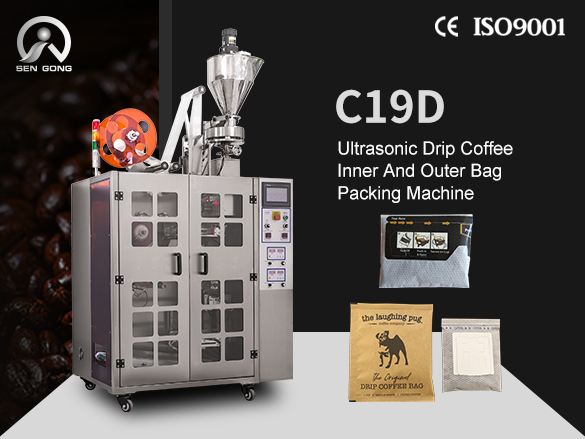
An automatic drip coffee bag packing machine can integrate dosing, filter-bag forming, and individual outer-pouch sealing into a continuous production process.
Typical stages include:
Feeding roasted coffee ground for drip brewing into the system;
Dosing the preset amount for each bag;
Filling coffee or a validated coffee blend into filter material;
Forming an inner bag with hanging supports;
Sealing and cutting the inner bag;
Transferring the completed filter bag into an individual outer pouch;
Heat-sealing, cutting, and discharging the finished package;
Applying optional dates, batch numbers, or traceability codes.
Automation can reduce manual transfer and improve consistency in coffee fill weight, filter-bag structure, and outer-pouch sealing.
Cardamom or other spices may change the particle size, density, oil content, and flowability of a coffee blend. Feeding stability should be tested using the real production formula—not only a pure coffee sample.
Spice particles and fine powders can affect flow through the filter. Finished products should be brewed under real conditions to assess drip speed, sediment, aroma release, and flavor balance.
When equipment packs both plain coffee and spiced products, hoppers, dosing components, and filling paths should be accessible for cleaning to reduce aroma carryover and formula cross-contact.
Ground coffee and botanical spices can be affected by moisture, oxygen, light, and external odors. Outer-pouch materials should provide suitable barrier and heat-sealing performance for the intended shelf life, logistics, and storage environment.
Equipment selection should not rely on rated output alone. Use real coffee, actual spice formulas, filter material, and outer-pouch film during trials, then check:
Whether feeding is continuous and stable;
Whether fill weights remain within the required range;
Whether filter seals and hanging-support placement are reliable;
Whether pouch forming, cutting, and heat sealing are stable;
Whether the finished product brews easily;
Whether the machine is easy to clean and change over;
Whether date, batch, and traceability functions meet operational requirements.
A real-material trial helps define an appropriate grind, dose, filter size, packaging material, and machine setting before commercial production.
Xiamen Sengong Packing Equipment Co.,Ltd provides drip coffee bag packing equipment and related solutions for coffee roasters, coffee brands, hospitality suppliers, private-label businesses, and contract packers.
Businesses can discuss coffee formula, spice ratio, filling weight, filter material, outer-pouch film, and output target with the equipment supplier. Packaging and brewing tests with actual materials can reduce development and scale-up risks.
Learn more about equipment and packaging solutions:
Saudi Arabian coffee culture provides distinctive flavor inspiration and strong brand value for modern single-serve products. Traditional Gahwa should not be transferred directly into a hanging-ear drip bag without validation. A more effective approach is to develop a modern filter-brewing coffee or a tested culture-inspired blend.
An automatic drip coffee bag packing machine supports precise dosing, hanging-ear filter forming, and individually sealed outer pouches. Success depends on matching the coffee recipe, spice particles, filter material, water flow, packaging material, and brewing guidance.
Counseling Hotline
+8613779964655
E-Mail:sales@quickerpack.com
Mobile:+8613779964655
TEL:+8613779964655
Addess:228, Tianfeng Road, North Industrial Zone, Jimei District, Xiamen, Fujian, China.
CopyRight 2004-2026 Xiamen Sengong Packing Equipment Co.,Ltd All Rights Reserved XML MAP